
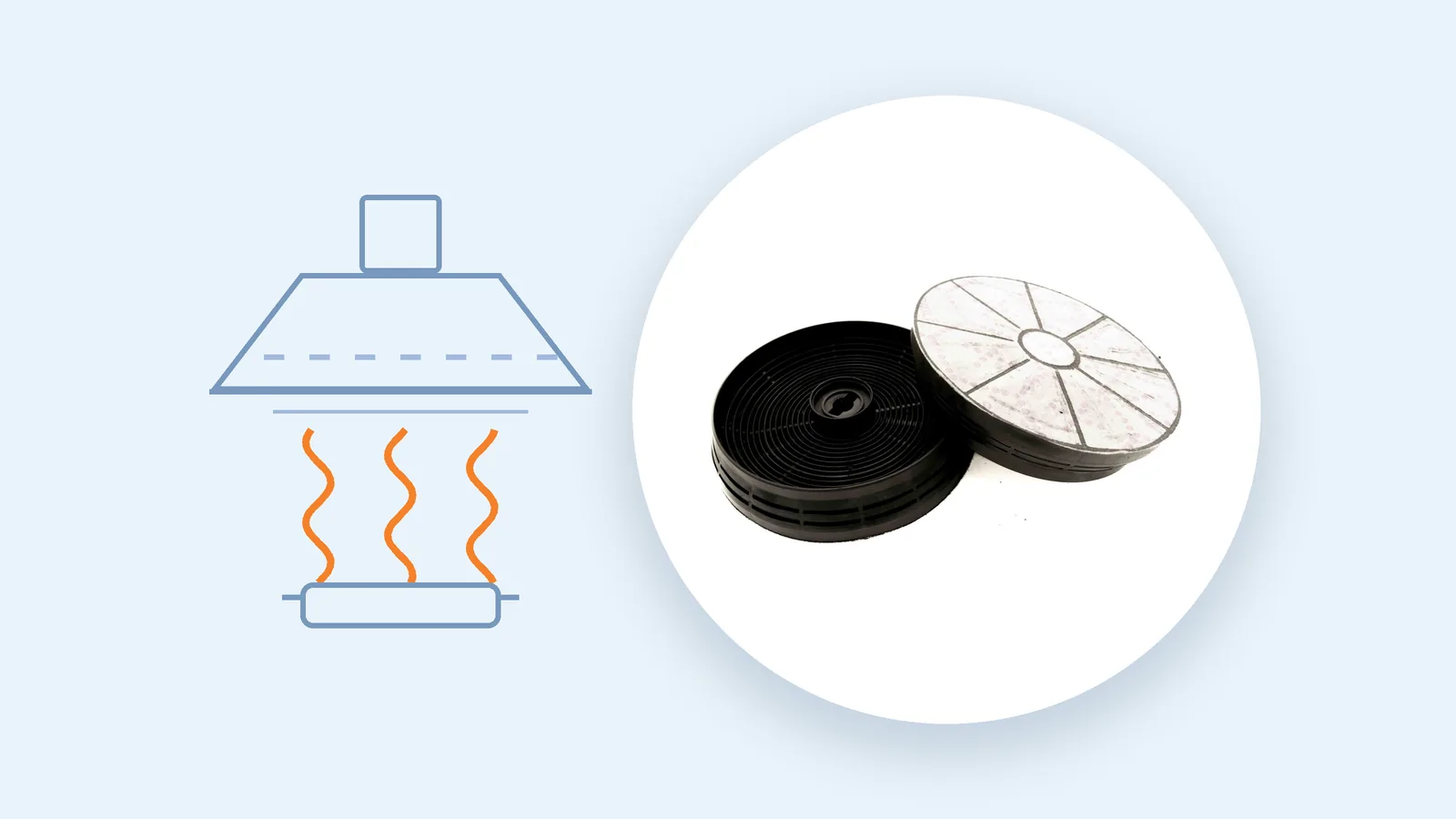
In this guide
The short answer
If your hood is not extracting, there are four causes: grease filters clogged with grease, an exhausted activated carbon filter (on recirculating hoods), a blocked or crushed exhaust duct and, more rarely, the motor or its capacitor. The filters are cleaned or replaced in a few minutes: carbon filters generally cost between €10 and €36, grease filters between €15 and €53.

Before you start: switch the hood off and unplug it (or cut the power at the switch). Built-up grease is slippery and the metal panels have sharp edges: wear gloves. If a step makes you uneasy, stop and call a technician.
Hood not extracting: how to identify the problem
A hood that works well carries away smoke and smells while you cook. If you now notice that steam rises and stays under the ceiling, or that the smell of frying lingers in the house for hours, the hood is not extracting as it should. First work out what type of hood you have, because it changes where to look:
| What you notice | Likely cause |
|---|---|
| Little air is drawn in, the metal filters are greasy or dripping | Grease filters clogged |
| Recirculating hood: the air comes out but the smell stays, and the filter has not been changed for months | Exhausted carbon filter |
| Hood with a duct to the outside: the motor runs but little air comes out, or you can hear noise and vibration | Blocked or crushed duct, stuck damper |
| The motor does not start, hums or runs very slowly | Faulty capacitor or motor |
To tell what type of hood you have, look at whether a pipe leaves the hood towards a hole in the wall or into the flue (extractor hood) or whether the air comes back into the kitchen through a grille at the top (recirculating, or filtering, hood). Recirculating hoods have the carbon filter, those venting to the outside normally do not.
1. Clean or replace the grease filters
These are the metal grilles you see under the hood: they trap the grease from cooking. When they are clogged the air passes with difficulty and the hood extracts much less, even if the motor seems fine. It is the most common cause, almost always the first to rule out.
- Take out the filters On most hoods they are released with a small lever or a spring catch; support them as you pull them out.
- Wash them In very hot water with degreaser or washing-up liquid, or in the dishwasher if the manual allows it (aluminium filters may darken).
- Let them dry Refit them only when they are completely dry.
- Check their condition If the mesh is deformed or punctured or the frame is bent, it must be replaced with an identical one.
As a general rule grease filters are washed every month or two, and more often if you fry a lot. The manual for your model gives the exact interval.
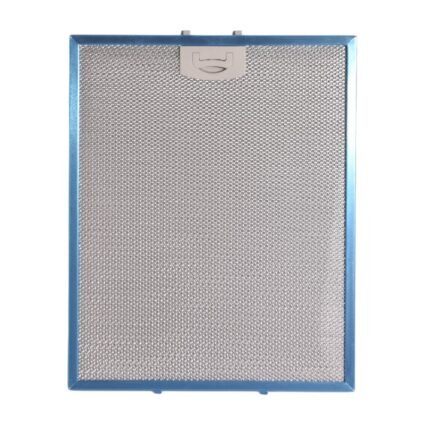
You will find the others among the metal grease filters for hoods.
2. Replace the carbon filter
On recirculating hoods, the activated carbon filter traps smells before the air returns to the kitchen. It cannot be washed: it wears out and has to be replaced, generally every three to six months, depending on how much you cook and what the manual says. When it is saturated, the air passes but the smells stay, and when it clogs the hood can also extract less.
- Take out the grease filters The carbon filter is behind them, near the motor.
- Look at the shape and size It may be round (diameter in millimetres) or rectangular, single or in a pair: note the dimensions or the printed code.
- Release the old one It comes off with a quarter turn or a small retaining spring.
- Fit the new one Place it in the same position and close the catch; then refit the grease filters.
The right filter depends on the brand and model of the hood: look for the code printed on the old filter, or the dimensions and shape. If you cannot, write to us on WhatsApp with the brand, model and a photo.
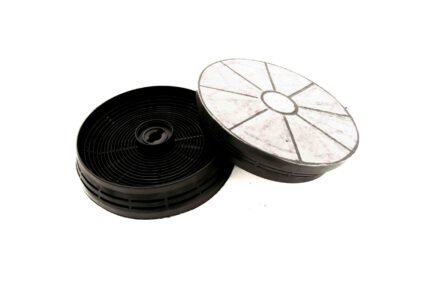
Some of the carbon filters we keep in the catalogue, for the main brands:
- Kit of 2 carbon filters for Faber, Franke, Ikea and Smeg hoods (Ø155 mm)
- Kit of 2 carbon filters for Elica, Whirlpool and Hotpoint Ariston hoods (Ø195 mm)
- Kit of 2 carbon filters for Falmec, Airlux, Candy and Hoover hoods (Ø168 mm)
- Carbon filter for Hotpoint Ariston, Indesit and Whirlpool hoods
- Kit of 2 carbon filters for Bosch, Balay and Airlux hoods (Ø185 mm)
All the others are among the carbon filters for hoods, sorted by brand and size.
3. Check the exhaust duct
If your hood vents to the outside, the pipe must be clear and as straight as possible. A crushed pipe, one with too many bends, one that is too long or one with a blocked outlet (a nest, a dirty grille, a damper that does not open) greatly reduces the air coming out.
- The pipe: check that it is not crushed, disconnected or full of grease inside.
- The outside outlet: check that the grille or damper opens when the hood is on.
- The incoming air: if the room is hermetically sealed, the hood struggles to draw in air to take outside: open a window and try.
- The length: a long pipe full of bends loses a lot of airflow: if you can, shorten it.
4. If the motor does not start or runs slowly
If the filters are clean, the duct is clear and the hood still extracts poorly, the motor may be weak or its starting capacitor worn out: the motor hums, runs very slowly or stops. A speed that does not change with the controls also points to a selector or board problem. It is a job for a technician, because you are working on live parts.
If instead the hood extracts well but the light does not come on, the fault is almost always the bulb or the diffuser: they are simple spare parts and you will find them among the hood bulbs and light covers, from about €2 to €24.
When it is worth calling a technician
Call a technician if the motor does not start, if you smell burning, if the controls do not respond or if the duct runs inside the wall and you cannot reach it. If you are not sure which filter to choose, see where to find the model and serial number in the guide model and serial number: where to find your appliance’s rating plate.
Frequently asked questions
Why is my hood not extracting as well as before?
Almost always because of the filters: grease filters clogged with grease, or an exhausted carbon filter on recirculating hoods. If they are fine, check the exhaust pipe (crushed or blocked) and the motor.
How often should the carbon filter on a hood be replaced?
Generally every three to six months, depending on how much you cook and what the manual for your model says. The carbon filter cannot be washed: when it is exhausted it has to be replaced.
How do I clean the grease filters on a hood?
You take them out and wash them in very hot water with degreaser or washing-up liquid, or in the dishwasher if the manual allows it. They must be refitted only when dry and cleaned every month or two.
How do I choose the right carbon filter for my hood?
It depends on the brand, model and dimensions. Look for the code printed on the old filter, or the shape and diameter, or send us the brand and model of the hood, which you will find on the rating plate, and we will tell you the right spare part.
Does a recirculating hood work without a carbon filter?
The motor runs, but the air returns to the kitchen with the smells: the carbon filter is there precisely to trap them. Without the filter the hood works, but it does not clean the air as it should.
The hood makes noise when on but extracts little: what could it be?
Usually it is the duct: a crushed pipe, a stuck damper or a blocked outlet, or clogged filters. If the noise and vibration remain with everything clean, it may be the motor or a bearing, and you need a technician.
How much do hood filters and spare parts cost?
In our catalogue, carbon filters cost from about €10 to €36 including VAT, most of them between €14 and €25. Grease filter grilles from about €15 to €53, bulbs and light diffusers from about €2 to €24.
Written by Di Gesù Ricambi. We have been selling appliance spare parts in Trapani since 1977, and every day we help customers and technicians find the right part.


 Account
 Categories

 Top