

In this guide
The short answer
If your fridge isn’t cooling, start with the simple things: door and seal, covered internal vents and dust at the back. If all that is fine, the most common causes are a fan that has stopped, ice on the evaporator in No Frost models, the thermostat or sensor and the compressor’s start relay. If the compressor runs constantly and nothing gets cold, the gas may be low: in that case you need a refrigeration engineer.
Fridge not cooling: the checks to do first
They take just a few minutes, and often the problem ends here, without taking anything apart:
- Temperature setting: the dial is easily knocked out of position during cleaning. The fridge should be kept between 4 and 5 degrees, the freezer at -18. To measure it, leave a thermometer in a glass of water on the middle shelf for a few hours.
- Door and seal: close the door on a sheet of paper. If the sheet slides out with no resistance, the seal isn’t holding at that point. Try it on every side.
- Internal vents: food and containers resting against the vents block the cold air.
- Back and surrounding space: if the grille behind or under the fridge is full of dust, the heat can’t escape. Clean it with the plug pulled out and leave a few centimetres of space from the wall.
- Just switched on or moved: if it was transported lying down, wait a few hours before switching it back on. After switching on, it can take up to 24 hours to reach the right temperature.
- Holiday or demo mode: on models with a display, the light and controls work but the fridge doesn’t cool as it should. Check the manual to see how to switch them off.
The 5 most common causes
- Fan not running In No Frost and fan-assisted fridges, it is the fan that carries the cold from the freezer to the fridge. If it stops, the freezer stays cold and the fridge warms up.
- Ice on the evaporator In No Frost models an automatic system melts the ice at intervals. If the defrost heating element, the sensor or the timer fails, the ice builds up until it blocks the air passage.
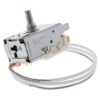
- Thermostat or sensor If the thermostat doesn’t close the contact, the compressor doesn’t start. Electronic models have a sensor that reads the temperature: if its reading is wrong, the control board doesn’t call for cooling.
- Start relay or compressor The compressor is the black motor at the back, at the bottom. If you hear a click every few minutes and it doesn’t start, it is often the relay, a part that costs a few euros. If it doesn’t start even with a new relay, the problem is the compressor.
- Low gas The compressor runs constantly but no cold arrives, and frost forms on the inside wall in one spot only. There is a leak in the circuit: it must be found and repaired by a qualified refrigeration engineer.
How to tell which cause it is
| What you notice | Likely cause | Where to look |
|---|---|---|
| Freezer cold, fridge warm | Fan or ice on the evaporator | Fans |
| Thick frost on the back wall of the freezer | Defrost system fault | Defrost heating elements and timers |
| Everything warm, compressor stopped and silent | Thermostat, sensor or control board | Thermostats and sensors |
| A click every few minutes, compressor not starting | Start relay or compressor | Relays and overload protectors |
| Compressor always running, everything lukewarm | Dirty back or low gas | Clean the back, then refrigeration engineer |
| Poor cooling, condensation around the door | Seal not holding | Magnetic door seals |
How to check the fan, defrost system and thermostat
The fan can be tested without taking anything apart. With the fridge switched on, open the freezer and hold down the little light switch, if there is one: many fans stop when the door is open, and this makes them start again. You should feel air coming out of the vents. For the other checks the plug must be pulled out.
Before you start: pull out the plug and move the food into a cool bag. Don’t remove ice with knives or other tools: you could puncture the gas circuit. Don’t cut or bend the pipes of the circuit.
- Defrost everything for 24 hours Leave the fridge switched off with the doors open and some towels at the bottom, then switch it back on. If it cools well for a few days and then the problem returns, the fault is in the defrost system.
- Test the defrost heating element It sits next to the evaporator, behind the back panel of the freezer. With the multimeter on the ohm range, place the probes on the two contacts: the expected value is 230 × 230 divided by the watts printed on the part, for example about 660 ohms for 80 W and 350 ohms for 150 W. If there is no reading, the element is open circuit.
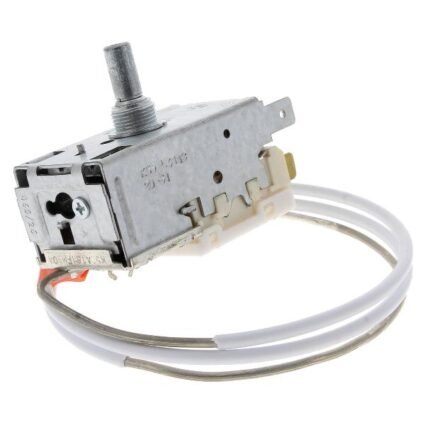
- Test the thermostat On models with a dial, take a photo of the connections, pull off the spade connectors and turn the dial to maximum. With the fridge warm, the multimeter should show continuity between the two contacts that control the compressor. If it doesn’t, the thermostat is faulty.
- Test the sensor On electronic models, measure the sensor with the multimeter, then hold its tip in a glass of water and ice for a minute. The value should change a lot. If it stays the same or there is no reading, the sensor is faulty.
- Check the relay Wait for the compressor to cool down and pull the relay off its side. If it is blackened or if, when you shake it, you hear pieces moving inside, it needs replacing. On recent fridges with an inverter compressor there is a small board instead of the relay, and this test does not apply.

How to replace the fridge thermostat
- Unplug and empty Plug pulled out and food kept cool in a cool bag.
- Open the thermostat housing It is usually behind the knob: pull off the knob and unscrew the cover or the light cover.
- Note the connections Take a photo of the spade connectors and pull them off one at a time.
- Pull out the bulb The thin tube is held by clips or slid into a guide. Look carefully at its route and where the tip ends up before removing it.
- Fit the new one Follow the same route and put the tip in the same spot. Don’t cut the thin tube and don’t bend it sharply: if it is longer, coil it in gentle curves.
- Test Put everything back together, switch on and check the temperature after a few hours, with the thermometer in the glass of water.
How to choose the right spare part
Thermostats, fans and sensors vary from model to model. Start from the code printed on the part or from the model and serial number, shown on the fridge’s rating plate.
Some spare parts for the most popular brands:
- Thermostat K59-L2680 for Beko fridge
- Fan for Indesit fridge
- Fan for Bosch fridge
- Fan for LG fridge
- LG defrost heating element 5300JB1092B
- Sensor for Samsung fridge DA32-00012A
- Candy magnetic door seal 58 x 70 cm
You’ll find all the parts among the spare parts for fridges and freezers. Not sure which one is yours? Message us on WhatsApp with a photo of the part and of the rating plate.
How much the spare parts cost
| Spare part | Price in our catalogue, VAT included |
|---|---|
| Relays and overload protectors | from €5 to €10 |
| Sensors | from €6 to €24 |
| Defrost heating elements | from €13 to €43 |
| Fans | usually around €23 |
| Thermostats | usually around €25 |
| Magnetic door seals | from €24 to €64 |
| Control boards | usually around €125 |
| Compressors | usually around €180 |
For the compressor and the gas, the refrigeration engineer’s labour is added to the price of the part. On an old fridge it is worth asking for a quote before deciding.
Frequently asked questions
The freezer works but the fridge isn’t cooling: what could it be?
In No Frost and fan-assisted models it is almost always a fan that has stopped, or ice blocking the air passage. Try defrosting everything for 24 hours: if it cools again for a few days, the fault is in the defrost system.
The fridge isn’t cooling but the motor is running: is it the gas?
Not always. First clean the back and check the fan: a fridge that can’t get rid of its heat also runs constantly and cools poorly. If all that is fine, it may be a gas leak and you need a refrigeration engineer.
Can I top up the gas myself?
No. The circuit has to be opened, the leak found and repaired, then the circuit sealed again and charged with the right amount. It is a job for a qualified refrigeration engineer, not least because the gas in many recent fridges is flammable.
How long does food stay safe to eat?
With the door closed, the fridge stays cold for about 4 hours. A full freezer holds for about 48 hours, a half-full one for about 24. If the food has been above 4-5 degrees for a long time or you have any doubts, throw it away.
After the repair, how long does it take to get cold again?
Usually a few hours, but it can take up to 24 hours to reach the right temperature. Wait until the thermometer reads 4-5 degrees before putting all the food back in.
Written by Di Gesù Ricambi. We have been selling appliance spare parts in Trapani since 1977, and every day we help customers and technicians find the right part.

 Account
 Categories

 Top