
In this guide
The short answer
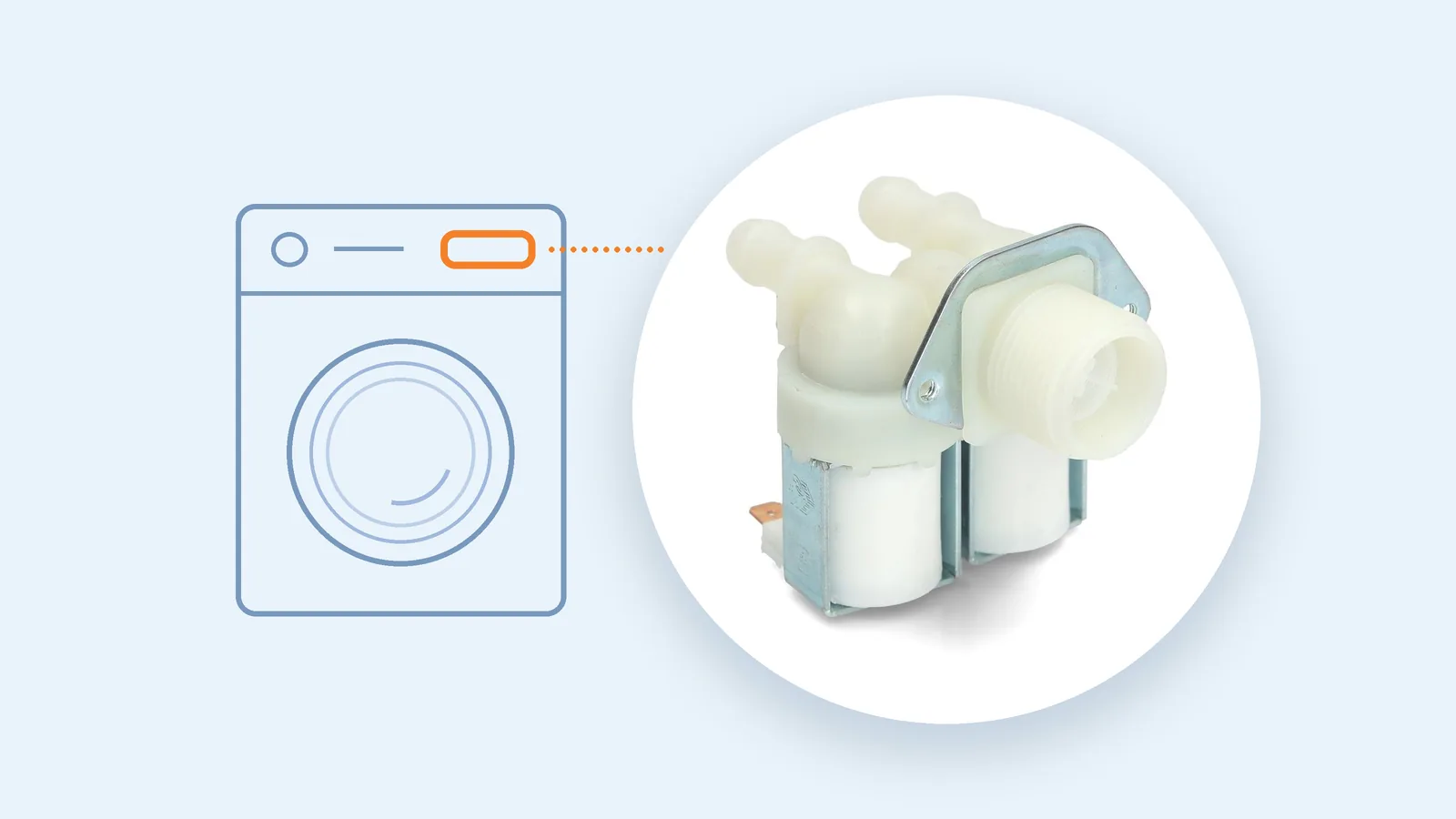
If your washing machine does not take in water, there are five possible causes: a closed tap or a crushed hose, a clogged inlet filter, a faulty solenoid valve, a pressure switch that does not read the water level and, sometimes, a door that does not lock. The first two need no spare parts; the solenoid valve and the pressure switch can be replaced in half an hour and usually cost between €12 and €28.
Before you start: unplug the machine and close the tap before disconnecting any hose, and keep a cloth and a bowl at hand: there is always a little water left in the hoses. If a step makes you uneasy, stop and call a technician.
Washing machine not filling with water: how to identify the problem
The sign is always the same: you start the programme and no water comes into the drum, or too little does. Depending on the cause, you will usually notice something else too:
| What you notice | Likely cause |
|---|---|
| No water comes in and you hear nothing; the hose looks crushed or the tap is closed | Tap closed or inlet hose kinked |
| Very little water comes in and it takes a long time, or the programme stops after a while | Clogged inlet filter |
| The tap is open and the hose is clear, but no water comes in and you cannot hear the valve hum | Solenoid valve faulty or blocked |
| Water comes in, but too little or too much, the programme does not move on or a level error appears | Pressure switch or its small tube |
| The machine will not even start, the display shows that the door is open | Door or door lock |
1. Check the tap and the inlet hose
This is the most common cause and costs nothing. Before opening the washing machine, look at what is happening outside:
- The tap: it must be fully open. If the water has been shut off or interrupted recently, open it and wait a minute.
- The pressure: open another tap in the house: if the water comes out weakly, the problem is in the plumbing and not in the washing machine.
- The inlet hose: check that it is not kinked or crushed behind the washing machine. Over the years the rubber hardens or swells: if you see bulges, cracks or signs of damp, replace it straight away, because it can burst and flood your home.
- The flow test: close the tap, disconnect the hose from the washing machine and put it in a bucket, then open the tap again: the water should come out strongly and clean.
If the hose needs replacing, we have several lengths in the catalogue, with a straight or elbow (angled) connector:
- Inlet hose for washing machines, 2 metres
- Inlet hose for washing machines, 2.5 metres, straight
- Inlet hose for washing machines, 3 metres, with elbow
- Universal inlet hose for washing machines, 3 metres, straight/straight
The others are among the inlet hoses for washing machines. They cost from about €5 to €9.
2. Clean the inlet filter
Where the inlet hose enters the washing machine there is a small screen, the filter, which stops sand and limescale. If it clogs, the water has difficulty getting through: filling becomes very slow, the machine stops or shows a no-water error (on many LG models it is IE, on many Samsung models 4E; if in doubt, check the manual). It often happens after plumbing work or in areas with very hard water.
- Close the tap and unplug the machine Put a cloth under the connector: a little water will come out.
- Unscrew the hose from the washing machine Look inside the connector: the screen is a small cylinder or a plastic disc with a mesh.
- Pull it out with pliers Pull it gently, without bending it. If it will not come out, push it from behind with a thin screwdriver.
- Clean it Under running water, with an old toothbrush. If it is full of limescale, soak it for an hour in water and vinegar.
- Check the tap too On some models there is a second screen on the tap side: check there as well.
- Refit and test Put the screen back the right way round, screw the hose back on by hand, open the tap and check that nothing leaks.
If the screen is broken or deformed, the inlet hose filter costs about one euro. While the hose is off, it is also worth checking the rubber seal of the connector: if it is hard or flattened, replace it.
3. Check the solenoid valve
The solenoid valve is the washing machine’s electric tap: it opens when the control board sends it current and lets the water in. It is at the top, at the back, where the inlet hose screws on. It can fail in two ways: the coil (the electrical part) burns out and the valve does not open, or the valve jams because of limescale. If instead it no longer closes, water keeps coming in even when the machine is off.
When the tap, hose and filter are all fine, the typical sign is this: the washing machine starts and does everything, but not a drop of water comes in. On valves with several ways, if only one coil is faulty, it is that compartment (for example the detergent) that gets no water.
- Unplug the machine and close the tap Here too, a cloth underneath: a little water will come out of the connector.
- Get to the valve On most models you remove the top panel (two screws at the back, then it slides back). The valve is at the top, on the left or the right, with one or more two-wire cables.
- Measure the coil with the multimeter Disconnect the two wires, set the multimeter to ohms and touch the probes to the terminals. A healthy coil usually reads a few thousand ohms (typically between 2 and 5 kΩ, depending on the model). No reading (open circuit) or zero means a burnt-out coil. On valves with several ways, measure each coil.
- Take a photo of the connections Before disconnecting the valve, photograph how the cables and hose clips are fitted.
- Remove it and compare Take off the clips and screws, slide out the valve and compare it with the new one: same number of ways, same position of the outlets and same voltage.
- Refit and check for leaks Open the tap, run a programme and make sure neither the valve nor the hoses drip.
To choose the right one, look at three things: the number of ways (one, two or three, one for each compartment of the drawer), the angle of the outlets (90° or 180°) and the coil voltage: most are 220-240 V, but there are also 12 V and 24 V ones. If you are in doubt, send us the model and serial number of your washing machine and we will tell you the right valve.

Some of the solenoid valves we keep in the catalogue:
- Solenoid valve, 1 way, outlet at 180°
- Solenoid valve, 2 ways, outlets at 180°
- Solenoid valve, 2 ways, for Bosch
- Solenoid valve, 3 ways
- Solenoid valve, 1 way, for Whirlpool
- Solenoid valve for Candy
You will find them all, sorted by type, among the solenoid valves for washing machines. Can’t identify yours? Write to us on WhatsApp with the model and serial number.
4. Check the pressure switch
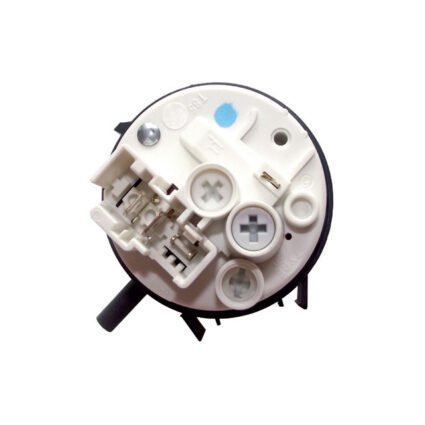
The pressure switch is the sensor that measures the water level in the tub: it does this through a small plastic tube that starts at the bottom of the tub. If the pressure switch or its tube are not working, the washing machine does not know how much water there is: it may stop filling too early, fill too much, stay idle or show a level error.
- The small tube: with the plug out, check that it is firmly on the pressure switch and that it is not cracked, kinked or clogged with foam and residue.
- The blow test: pull the tube off the pressure switch and blow gently into the pressure switch (not into the tube): you can usually hear a small click, sometimes two. No click means the pressure switch needs replacing.
- The free tube: blow into the tube: the air must pass freely. If it is blocked, wash it with warm water and vinegar.
A pressure switch cannot be repaired: if it is faulty, it is replaced, in a few minutes. There are different models by brand and number of levels, so compare the code printed on yours.
The ones we have in the catalogue:
The others are among the pressure switches for washing machines.
5. Check the door and the door lock
The washing machine does not take in water until the door is closed and locked. If the door does not click shut, or the door lock does not engage, the programme does not start and a door-open error may appear on the display. Close it firmly and listen: you should hear a click and then the small click of the lock.
- The handle and the hook: check that the hook is not broken or bent and that it fits properly into the lock.
- The hinges: if the door has dropped, it does not reach the lock.
- The door lock: if everything is fine and the machine does not start, it may be faulty or burnt out.
For these spare parts, see the door handles, the door hinges and the door locks for washing machines.
When it is worth calling a technician
If you have checked the tap, filter, solenoid valve, pressure switch and door and the washing machine still does not fill, the cause may be in the electronic board that controls the valve. It is a fault that cannot be found without instruments: if the machine is still under warranty, it is better not to take it apart and to call a technician. If instead the washing machine takes in water but does not spin, see the guide washing machine not spinning: 5 causes and what to check; if it does not drain, the guide washing machine not draining: filter, hose or pump?.
Frequently asked questions
My washing machine does not take in water: what should I check first?
Check the tap (fully open), that the inlet hose is not kinked and that the water arrives with force. Then clean the filter where the hose enters the washing machine. These are the two most frequent causes and need no spare parts.
How can I tell whether the solenoid valve is faulty?
If the tap, hose and filter are fine and no water comes in, measure the coil with the multimeter, with the plug out: a few thousand ohms is normal, no reading means a burnt-out coil. If the valve has several coils, measure them one by one.
Can I replace the solenoid valve myself?
Yes, half an hour and a screwdriver are usually enough. Close the tap, unplug the machine, photograph the connections, replace the valve with an identical one (same ways, same outlets, same voltage) and check that nothing leaks.
How do I choose the right solenoid valve?
Look at the number of ways (one, two or three), the angle of the outlets (90° or 180°) and the coil voltage (220-240 V in most cases, but there are also 12 V and 24 V ones). If you are in doubt, send us the model and serial number and we will tell you.
My washing machine keeps taking in water, even when switched off: what could it be?
Usually the solenoid valve no longer closes, because of limescale or a worn seal. Close the tap straight away to avoid flooding and replace the valve. More rarely the cause is the pressure switch.
What is the pressure switch for and how do I test it?
It measures the water level in the tub. With the tube disconnected, blow gently into the pressure switch: if you hear no click, it needs replacing. First check that the tube is not blocked.
How much do a solenoid valve, a pressure switch and an inlet hose cost?
In our catalogue, solenoid valves cost from about €12 to €45 including VAT, most of them between €13 and €28. Pressure switches cost from about €12 to €28. Inlet hoses from about €5 to €9.
Written by Di Gesù Ricambi. We have been selling appliance spare parts in Trapani since 1977, and every day we help customers and technicians find the right part.


 Account
 Categories

 Top