
In this guide
The short answer
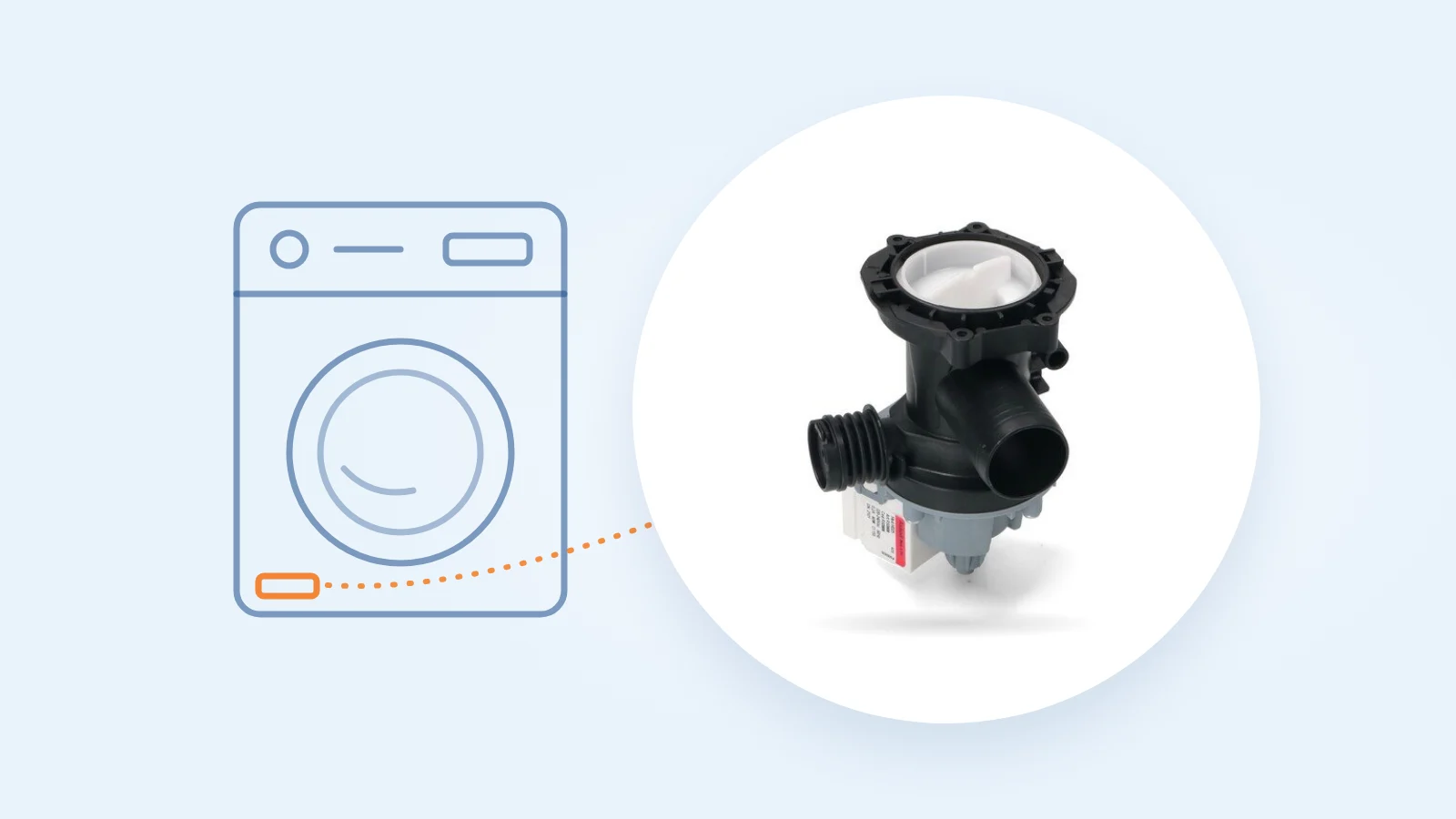
If the washing machine doesn’t drain, there are almost always three causes: a clogged pump filter, a kinked or blocked drain hose or a faulty drain pump. Check them in this order: the first two are sorted in a few minutes and without spare parts; the third needs a new pump, which usually costs between €15 and €30.
 POMPA ASKOLL16,01 € VAT included
Before you start: pull out the plug, turn off the water tap and, if the last wash was at a high temperature, wait for the water to cool down. Keep a shallow basin and a few cloths to hand: the water left in the drum will come out of the filter.
Washing machine not draining: how to recognise the problem
The drain is blocked when one of these things happens:
- at the end of the programme there is water left in the drum, or the laundry comes out soaking wet;
- the programme stops before the spin, or the spin doesn’t start;
- you hear a hum from the lower part of the washing machine, but the water doesn’t come out;
- a drain error code appears on the display.
The codes vary from brand to brand, sometimes even from model to model. These are the most common; if in doubt, check your washing machine’s manual.
| Brand | Drain error code |
|---|---|
| LG | OE |
| Samsung | 5E, SE or 5C |
| Bosch and Siemens | E18 (F18 on older models) |
| Electrolux, AEG e Zanussi | E20 |
| Candy and Hoover | E03 |
| Indesit and Hotpoint Ariston | F05 |
1. Clean the pump filter
This is the most frequent cause and also the easiest to fix. The filter catches everything that comes out of pockets and garments: coins, buttons, bra underwires, clothes pegs and fluff. When it clogs up, the water can no longer get through.
- Find the flap It is usually at the bottom right of the front, sometimes on the left or behind a plinth that unclips.
- Let the water out If there is a small emergency hose next to the filter, pull it out, remove the cap and empty the water into the basin. If there isn’t one, unscrew the filter half a turn at a time and let the water drain out slowly.
- Remove and clean the filter Pull it out completely, remove any foreign objects and rinse it under the tap. Look inside the filter housing too, with a torch.
- Check the impeller Inside the housing you can see the pump’s small impeller. Turn it with a finger: it should move with a little play and a few clicks, without jamming. If it is stuck, stiff or broken, the problem is the pump (step 3).
- Reassemble and test Screw the filter back in fully, otherwise it will leak, and run a drain-only or spin programme.
If the washing machine now drains, you’ve fixed it. To stop it happening again, clean the filter every two or three months and always empty pockets before washing. If the filter is broken or no longer seals, you’ll find replacements among the washing machine filters and filter housings.
2. Check the drain hose and the wall drain
If the filter is clean but the water stays in the drum, check the water’s path after the pump.
- Kinked or crushed hose: this often happens when the washing machine is pushed against the wall. Move it a few centimetres and straighten the hose.
- Wrong height: the highest point of the drain hose should usually be between 60 and 100 centimetres from the floor. Higher up, the pump struggles; lower down, the washing machine can empty itself while it is filling.
- Blocked household drain: pull the hose out and pour a bucket of water into the wall drain or the sink trap. If the water stands, the problem is in the household plumbing, not in the washing machine.
- Blocked internal hose: between the tub and the pump there is a sump hose where a sock or a handkerchief sometimes gets stuck. You reach it by removing the pump, as we explain further down.
If the internal hose is cracked or damaged, you’ll find it among the washing machine hoses and sleeves.
3. Check the drain pump
If the filter and hose are fine, the fault is almost always in the pump. Two signs help you tell:
- Humming but no draining: the pump is getting power but the impeller is jammed or broken. Sometimes removing a foreign object is enough; if the impeller is snapped, the pump has to be replaced.
- Total silence: the pump coil may be burnt out. With a multimeter, measure the resistance between the pump’s two contacts after unplugging the connector: if it shows no reading, the coil is open and the pump needs replacing. A healthy pump usually reads between 100 and 250 ohms. If the pump is fine but no power is reaching it, the fault is in the wiring or the control board: in that case it’s best to call a technician.
How to replace the pump
It depends on the model: on many washing machines the pump is reached from below, by tilting the machine onto its side; on others you have to remove the front or rear panel. The steps are always the same:
- Empty and disconnect Plug out, tap closed, water drained through the filter.
- Reach the pump Remove the panel or tilt the washing machine, resting it on a blanket.
- Disconnect the connector and hoses Take a photo before dismantling, so you remember where the wires go. Loosen the clamps and pull off the hoses: a little more water will come out.
- Unscrew the pump It is usually held by two or three screws, or by a bayonet fitting that you twist.
- Fit the new pump Reassemble everything in reverse order, check that the clamps are tight and run a drain-only programme, watching for leaks.

How to choose the right pump

Pumps all look alike, but they differ in fitting (screws or bayonet), connector position, power and the shape of the filter body. The safest way is to start from the code printed on the label of the old pump, or from the model and serial number of the washing machine.
Some drain pumps for the most common brands:
- Drain pump for Beko washing machines
- Magnetic pump 1327320121 for Zanussi and Electrolux washing machines
- Drain pump for LG washing machines
- Bosch drain pump 145338
- Drain pump 119307 for Indesit and Ariston washing machines
- Drain pump for Samsung washing machines
You’ll find them all, sorted by brand, among the washing machine drain pumps. Not sure which one is yours? Message us on WhatsApp with the model and serial number: we’ll tell you the right code.
When it is worth calling a technician
If the washing machine still doesn’t drain after you have cleaned the filter, checked the hose and fitted a new pump, the fault may be in the pressure switch (the sensor that measures the water level), the wiring or the control board. In these cases, and if the washing machine is still under warranty, it’s better not to dismantle it and to call a technician.
Frequently asked questions
The washing machine won’t drain and won’t spin: is it the same problem?
Almost always, yes: the washing machine won’t start the spin until the water has left the drum. Once the draining is fixed, the spin usually comes back too.
Can I drain the washing machine by hand?
Yes. Use the small emergency hose next to the filter, if there is one, or unscrew the filter very slowly over a shallow bowl. Alternatively, you can lower the drain hose into a bucket standing on the floor.
How often should the pump filter be cleaned?
Every two or three months, and straight away if you notice the washing machine draining more slowly than usual or leaving the laundry wetter.
Does a compatible pump work like the genuine one?
Yes, if the fittings, connector and power match those of the original pump. Send us the code of the old pump or the serial number of the washing machine and we’ll point you to the right one.
How much does a washing machine drain pump cost?
In our catalogue, washing machine drain pumps cost from about €13 to €46 including VAT; most are between €15 and €30.
How long does it take to change the pump?
Usually from half an hour to an hour: it depends on how easy it is to get to the pump on your model.
Written by Di Gesù Ricambi. We have been selling appliance spare parts in Trapani since 1977, and every day we help customers and technicians find the right part.


 Account
 Categories

 Top